

A resilient world, powered by the sun.
To realize a 100% clean energy future through a solutions-driven, people-first approach.
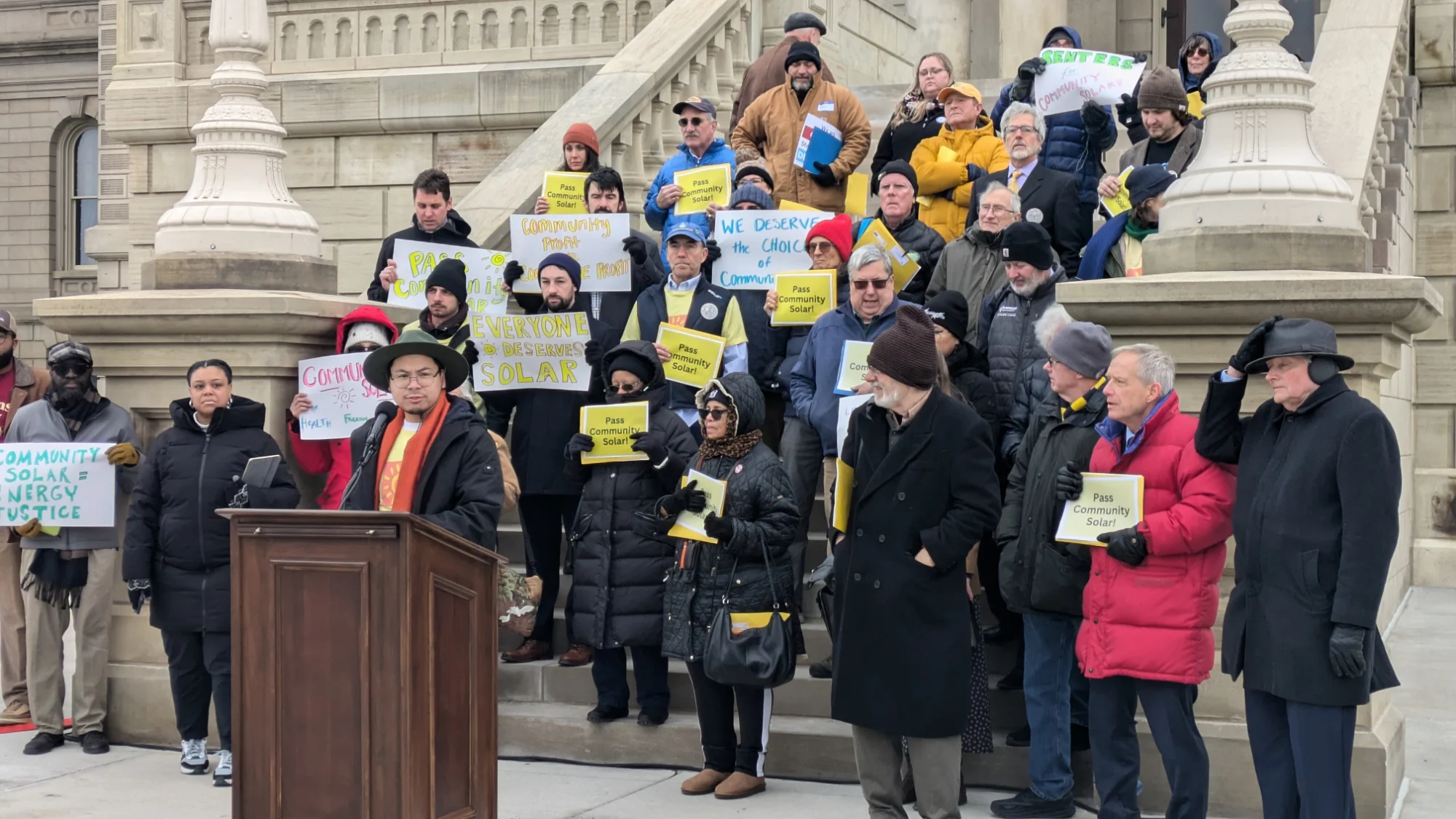
Midwest Regulatory Manager, Boratha Tan, speaking at a Community Solar Lobby Day in Michigan
Five-Year Strategic Plan
For nearly twenty-five years, Vote Solar has been working at the state level—where most energy decisions are made—to propel the transition to a clean energy future for all. Our Five-Year Strategic Plan builds on that foundation by focusing on the areas where Vote Solar’s unique expertise and skillset are guaranteed to have the most impact.
Today, in the face of growing demand for energy and federal support for fossil fuels, Vote Solar is working in states across the country to drive 184 gigawatts of local solar solutions by 2035 and 250 gigawatts by 2040.
Our Theory of Change
Build and deploy local clean energy. Build strong relationships and powerful alliances with energy and justice organizations through education and learning.
Integrate local solar solutions into the larger energy system by using the collective power of these resources to make the system more affordable, reliable, and resilient. Integrate community voices and interests into regulatory and energy policy proceedings.
Accelerate clean energy adoption through modernized and flexible grids. Accelerate progress through community empowerment and demonstrated impact.

Key Strategies

Accelerate the deployment of local solar solutions

Transform the energy system to center local solar solutions and replace fossil fuel combustion

Increase the power of frontline communities to win holistic, equitable outcomes and contribute to a durable, transformative movement for a clean energy system

Build awareness and support for an equitable transition to clean energy, activating communities and key stakeholders
Our Work in 2026
Accelerating the clean energy transition in more than 20 states
Vote Solar will advance bold, state-based policy and regulatory solutions to make solar power more accessible, affordable, and reliable. For over two decades, Vote Solar’s work has driven down the cost of solar and helped transform it from a niche technology to the fastest-growing source of new electricity in the country. Working across state legislatures, utility regulatory commissions, and local communities, the team defends and expands access to solar solutions nationwide. From shaping utility rules to empowering frontline advocates, Vote Solar is building a solar-powered future that works for everyone.
Why Vote Solar?
While the transition to cleaner, more affordable energy is well underway, monopoly utilities and their fossil allies are ever more desperately resisting, and throwing up roadblocks to progress. To counter this, Vote Solar is building the broadest, most diverse coalitions and constituencies possible, supporting the overall movement toward a more resilient, affordable, clean, and abundant energy system. By providing expert, data-driven advocacy and testimony to promote solar as a key element of our clean energy future, Vote Solar ensures that people, the public good, and the planet are well-represented in policy debates.
West
The West has a diverse energy landscape characterized by rapid growth – often used to justify keeping fossil fuel plants online. Despite facing utility resistance and grid constraints, Vote Solar is counteracting regulatory capture by advancing distributed energy resources. By leveraging strong frontline coalitions and supportive state leadership, we are shifting the narrative to frame clean energy as a vital solution for wildfire resilience, increasing energy demand from data centers, and long-term affordability.
Midwest
The Midwest has emerged as a leader in decarbonization, grid modernization, and clean energy adoption. However, the region now faces new challenges from the resurgence of coal to rising energy demand. Vote Solar is meeting these headwinds by leveraging our regional expertise to bridge the gap between technical policy and community needs, ensuring that local clean energy remains a priority for decision-makers. By advancing solutions like virtual power plants, instant permitting, and community solar, we are holding utilities accountable and securing a reliable, equitable grid.
East
The East has vastly different regulatory landscapes that vary state-by-state. All of which share a critical need for energy affordability and grid resilience in the face of climate-caused natural disasters. Vote Solar is bridging the gap between technical policy and community needs by challenging utility profit motives and pushing for reforms in rate cases and resource planning. Our strategy prioritizes immediate, accessible solutions like plug-in solar and distributed energy resources to bypass interconnection bottlenecks and directly benefit under-resourced families. By holding utilities accountable and advancing performance-based regulation, we are ensuring the clean energy transition is both reliable and equitable.
State Campaigns
Arizona
Vote Solar’s work in Arizona will focus on defending hard-won progress while expanding access to local solar in one of the nation’s most politically complex environments. With the Arizona Corporation Commission (ACC) advancing rollbacks to clean energy and efficiency standards and utilities pushing narratives that undermine rooftop solar, Vote Solar will anchor the public conversation in transparent data, consumer benefits, and community-driven solutions. We will intervene in the Arizona Public Service rate case to stop increases to the utility’s discriminatory Grid Access Charge on solar customers and oppose efforts to give the utility a “blank-check” formula rate. At the legislature, we will work with partners to stop utility-backed attacks on clean energy and build bipartisan momentum for instant permitting, plug-in solar, and affordability measures. Through plain-language education, bilingual materials, and nonpartisan community workshops, we will work to increase public understanding of the ACC and the Salt River Project Board ahead of high-stakes 2026 elections that will shape Arizona’s clean energy future. Together, these efforts will help ensure Arizona’s extraordinary solar potential delivers real economic and resilience benefits to the communities that need them most.
California
Vote Solar will work to reassert the value of local solar solutions in California and rebuild momentum for equitable clean energy solutions in a market where harmful regulatory decisions and utility-driven narratives have stalled progress. The California Public Utilities Commission and the California Energy Commission continue to advance “cost-shift” arguments that undermine local solar while investor-owned utilities raise rates to record levels. We will leverage strong statewide organizing, broad public support for climate action, and California’s robust clean energy laws to counter these narratives and strengthen the role of community-based power, such as virtual power plants (VPPs) and other local solar solutions. Through targeted regulatory efforts that ensure state energy plans account for the full benefits of local solar, accountability campaigns that tie affordability to utility behavior, and legislative advocacy to pass policies and budget items that accelerate local solar and VPP deployment, we will push to restore California’s clean energy leadership. Paired with targeted public awareness campaigns and coordinated engagement in Sacramento, our work will help rebuild durable support for clean, community-centered energy across the state in 2026.
Colorado
Vote Solar will work to protect Colorado’s role as a regional clean energy leader by defending net metering, strengthening utility accountability, and ensuring communities—not utilities—shape the state’s clean energy future. Amid increasing “cost-shift” narratives that blame clean energy for higher energy prices, continued pressure to extend fossil assets, and major uncertainty surrounding the sale of Black Hills Energy, our efforts will center on safeguarding fair rooftop solar compensation, preventing unfair fees for solar customers, and ensuring the Public Utilities Commission (PUC) remains empowered to regulate utilities and advance environmental justice. We will intervene in long-term planning to push back on new gas plants, advance the implementation of Colorado’s Just Transition and equity rulemakings, and help shape the rollout of inclusive community solar programs so income-qualified households see meaningful benefits. At the legislature, we will fight to create new mandates and tools for the PUC in its reauthorization bill and new pathways for renters through plug-in solar, ensuring Colorado continues to expand affordable, accessible solar options across the state.
Connecticut
Vote Solar will work to protect and advance Connecticut’s landmark clean energy reforms at a moment of significant regulatory uncertainty. After years of leading the fight to establish a nation-leading performance-based ratemaking (PBR) framework that aligns utility profits with climate, equity, and consumer outcomes, recent leadership changes at the Public Utilities Regulatory Authority (PURA) now threaten to unravel hard-won progress. Our focus this year will be twofold: defending the integrity of the PBR decision so utilities are finally held accountable for delivering public benefits, and safeguarding fair solar compensation as PURA reevaluates the state’s renewable energy tariff programs. By combining strong technical advocacy, coalition leadership, and increased public engagement, Vote Solar will push to ensure Connecticut stays on a path toward a more transparent, equitable, and consumer-focused clean energy future.
Florida
Vote Solar will build on growing public awareness of clean energy as a tool for affordability and storm resilience in Florida, even as powerful utilities and a challenging political environment continue to slow progress. After spending 2025 strengthening partnerships with frontline and technical advocates and preparing for key regulatory and legislative fights, our focus will shift to protecting fair solar compensation and stopping efforts to undermine net metering. We will mobilize our members to push back against municipal utility attempts to impose new fixed charges and reduced export rates, while making clear to state legislators that renewed attacks on net metering carry real political risk. By elevating consumer voices, reinforcing pro-solar narratives around choice and savings, and maintaining constant pressure at the local and state level, Vote Solar will work to ensure that anti-solar policies are not treated as an acceptable solution to Florida’s energy and revenue challenges.
Illinois
Vote Solar will continue our work in Illinois, which is well-positioned to lead the Midwest in clean energy ambition, backed by strong coalitions, supportive leadership, and major legislative wins. The passage of the Clean and Reliable Grid Affordability (CRGA) Act in October 2025 represents one of the most important climate and affordability accomplishments in the country, securing $235 million annually for new clean energy, authorizing virtual power plants, expanding storage, modernizing resource planning, and establishing equitable solar + storage programs. Vote Solar’s deep involvement in drafting and passing CRGA positions us to play a central role in shaping how the law is implemented and strengthened, particularly the new Integrated Resource Plan (IRP) framework from the bill. As reliability pressures grow, peak demand rises, and data center expansion accelerates, this year will be about ensuring CRGA delivers real, visible benefits to households, driving a slate of targeted follow-up improvements, and embedding new ideas like plug-in solar, instant permitting, and equitable storage expansion into the policy mainstream. Our work this year will focus on regulatory engagement, coalition leadership, and continued legislative strategy to keep Illinois at the forefront of the just energy transition.
Indiana
Vote Solar’s work in Indiana is critical; as the nation’s third-largest coal consumer, Indiana remains in the early stages of solar adoption, with a state commission that is not climate-friendly and utilities now using data center load growth to justify new fossil fuel investments. Despite these challenges, Vote Solar has continued collaborating closely with clean energy champions on the ground to block new gas from coming online and demonstrate the reliability and affordability of local clean energy resources. This year, Vote Solar will focus on empowering local partners to block proposed natural gas expansion from the Northern Indiana Public Service Company (NIPSCO). We will support the Citizens Action Coalition in the NIPSCO Integrated Resource Plan docket and related Certificate of Public Convenience and Necessity cases to show that projected load can be met through renewable procurement and customer-sited solutions rather than rate-based gas plants. Our work will advance data center accountability mechanisms, such as tariffs, to ensure massive infrastructure costs are covered by large data center customers rather than passed on to residential ratepayers through bill spikes, and defend the retirement schedules for the Schahfer and Michigan City coal plants. While our bandwidth for Indiana work is limited, our support of CAC is emblematic of how we can do more together. Vote Solar will be helping CAC to help them design and influence a Virtual Power Plant pilot for Indiana & Michigan Power that they won through a settlement last year.
Massachusetts
Vote Solar’s work to advance local solar solutions in Massachusetts has positioned it as one of the nation’s clean energy leaders, but the state is falling behind its own climate and affordability goals due to persistent permitting delays, limited grid capacity, and a siting process that has not kept pace with market needs. At the same time, the Commonwealth has major structural advantages, including a mature solar industry, strong interest in community solar, a clean-energy-aligned governor, and a broad legislative appetite for reform. In 2025, Vote Solar helped introduce a suite of bills aimed at accelerating local solar deployment, fixing interconnection barriers, creating a long-range framework for local solar, and embedding environmental justice standards across programs. This year, our work will center on ensuring these proposals advance through the Governor’s affordability agenda and the anticipated climate omnibus. On the regulatory front, we will drive market reforms that restore Massachusetts as a growing, accessible solar market and expand the role of community-based power in meeting reliability and cost challenges.
Michigan
Vote Solar will work to keep Michigan’s clean energy transition affordable, community-centered, and rooted in local solar solutions as the state faces rising energy costs, interconnection backlogs, large-load growth from data centers, and renewed pressure to keep coal online. Despite headwinds from a divided legislature, we will lay the groundwork for legislation that enables community solar and a statewide virtual power plant (VPP) program, and begin introducing the concept of plug-in solar. Across upcoming DTE Energy and Consumers Energy rate cases and Integrated Resource Plans, we will push for equitable grid investments, strong commitments to clean energy and storage, and fair treatment of data center load growth while working with partners to ensure ratepayers and frontline communities are heard. The Michigan Public Service Commission’s recent accelerated approval of a 1.4 GW data center in DTE service territory highlights the need to double down on our advocacy around new resources and load growth – we anticipate that data centers will take center stage as we approach the next IRPs. Through complementary legislative campaigns advocating for community-based power—such as virtual power plants—and by coordinating closely with Michigan’s robust advocacy ecosystem, Vote Solar will help the state open the door to innovative, community-based clean energy technologies and business models that lower costs for all consumers.
Minnesota
Vote Solar will build on recent wins protecting community solar and net metering by advancing policies that speed up local solar + storage deployment, keep energy costs down, and make sure existing household resources play a meaningful role in meeting Minnesota’s growing electricity demand. With a politically split legislature and new pressures from energy-intensive data centers, our work will center on defending net metering, improving Xcel’s Distributed Capacity Procurement to properly value local storage, and advancing a statewide virtual power plant program. We will also work to strengthen affordability and equity in Xcel’s rate case, modernize outdated demand-response rules, and help shape grid-planning efforts so utilities prioritize local, cost-effective solutions. Legislatively, we will support a package of local solar bills, including virtual power plants, instant permitting, and plug-in solar, as well as new policy that would require data centers to bring their own clean energy. Through close collaboration with partners, our efforts will help expand access to local solar, protect under-resourced communities, and help keep Minnesota on track for its 2040 carbon-free electricity target.
Nevada
Vote Solar will continue to push for utility accountability in Nevada, where energy decisions are heavily shaped by NV Energy and large corporate casinos. This imbalance has made it harder for everyday Nevadans to access local, customer-owned solar and other clean energy options. Our recent regulatory interventions reshaped the utility’s long-term planning and exposed how proposed net metering changes and new gas investments would raise costs and limit consumer choice. These fights now set the stage for 2026, when Nevada regulators will revisit the utility’s long-term resource plans, consider reforms to net metering, and weigh broader changes to how utilities are held accountable and transparent with the public. With a supportive governor, growing interest in Public Utility Commission reform, and increasing public demand for energy independence, Vote Solar is positioned to challenge unnecessary gas expansion, defend rooftop solar, and build the political will needed to advance plug-in solar and strengthen consumer protections across Nevada.
New Jersey
Vote Solar will help position New Jersey to meet rising electricity demand by modernizing its grid and expanding opportunities for locally sited clean energy. Although the state relies heavily on imported power, recent legislative victories—including 3 GW of new community solar capacity and streamlined permitting—have laid the groundwork for a more resilient, affordable, and home-grown clean energy economy. This year, we’ll build on that momentum to defend a strong valuation for local solar as the state reevaluates its net metering framework, ensuring the Board of Public Utilities recognizes the full environmental and social benefits that solar provides. We will also champion new pathways for participation, including authorizing plug-in solar as an accessible option for renters and households that cannot install rooftop systems. Together with frontline partners, Vote Solar will work to strengthen grid infrastructure, expand local generation, and ensure that low-wealth customers share in the economic and health benefits of New Jersey’s clean energy transition.
New Mexico
Vote Solar will focus on defending and fully implementing New Mexico’s new local solar and community benefits laws in one of the most favorable clean energy political environments in the Interior West. While regulatory and utility delays, project bottlenecks, and slow interconnection queues continue to threaten community and rooftop solar timelines, momentum for equitable local solar expansion remains strong. We will work with partners to ensure that funding from the Local Solar Access Fund and Community Benefits Fund is protected during the short legislative session, directed to historically disinvested communities, and implemented through aligned, transparent protocols. Through coordinated legislative defense, stakeholder engagement, and public communications that highlight early program wins, we will help ensure these landmark investments deliver immediate economic relief and durable clean energy access across New Mexico.
New York
Vote Solar will work to close the gap between New York’s ambitious climate goals and the state’s slow progress by advancing both legislative and regulatory reforms that unlock local solar growth, reduce development barriers, and improve affordability. Building on recent wins—including influencing the New York Power Authority’s clean energy buildout plan and generating momentum behind the ASAP Act—we will push to double New York’s local solar target to 20 GW by 2035, secure long-overdue regulatory fixes that lower costs and accelerate timelines, and champion plug-in solar as a low-cost, fast-deployment option for households. We will intervene in utility rate cases to dismantle interconnection bottlenecks, challenge unfair utility practices that stifle clean energy, and mobilize partners across the climate, justice, and industry landscape to build a more accessible, developer-friendly solar market. Together, these efforts position New York to deliver meaningful affordability benefits, expand access to clean energy, and translate climate ambition into tangible progress.
North Carolina
Vote Solar will continue to find pathways to expand solar adoption in North Carolina, where the state’s energy landscape continues to be shaped by the influence of Duke Energy, which dominates the state’s utility sector. This year, Vote Solar will work to accelerate North Carolina’s transition toward community-driven clean energy by pushing Duke to fully leverage distributed resources, like local solar, in the state’s resource planning and regulatory processes. As the utility cites unprecedented load growth to justify a massive buildout of new gas plants, we will counter that narrative with technical modeling that demonstrates how flexible, customer-powered solutions—like virtual power plants, plug-in solar, and demand-side capacity—can reliably meet peak demand at lower cost. At the same time, we will use emerging “regulatory sandbox” tools to pilot innovative programs, like virtual power plants, to expand access to clean energy for low-wealth households and create new pathways for affordable solar adoption. By pairing rigorous evidence with strong public engagement, Vote Solar will work to hold Duke accountable, protect customers from unnecessary fossil fuel spending, and ensure North Carolina’s clean energy future is more resilient, affordable, and community-led.
Pennsylvania
Vote Solar will build on our momentum in Pennsylvania, which, as a major fossil energy producer, lags behind its neighbors on clean energy. Our work in 2025 advanced stronger coalitions and bipartisan progress on community solar, including a landmark rate case settlement that will save Philadelphia Gas Works customers millions while setting a precedent for future clean energy gains. This year, Vote Solar will focus on unlocking Pennsylvania’s long-stalled clean energy potential by advancing legislation to authorize community solar, securing enabling policies for plug-in solar as an affordable solution to rising energy costs, and shaping the Commonwealth’s renewable portfolio standard update to prioritize equity and local clean energy development. We will strengthen consumer protections by intervening in the PPL Electric Utilities rate case to prevent households from subsidizing large data centers and to require a dedicated rate class that accurately reflects their true grid impacts. And we will continue leading the push for interconnection reform, pressing the Public Utilities Commission to adopt best-practice standards that clear the backlog and enable local solar to come online. Together, these interventions will expand affordable clean energy access, protect ratepayers, and position Pennsylvania to meet growing energy demand with reliable, community-centered renewable power.
South Carolina
Vote Solar will continue to advocate for a clean energy future in South Carolina, which faces rising energy burdens and entrenched utility resistance. The passage of the SC Energy Security Act (Act 41) in 2025 has fundamentally reshaped the landscape heading into 2026. Although Act 41 accelerates gas permitting, it also includes clean energy wins that now require vigilant enforcement. Building on the 2025 Public Service Commission approval of the renewable-heavy portfolio we supported in Duke Energy’s Integrated Resource Plan, and on our interventions in ongoing rate cases, Vote Solar will use this year to ensure that Act 41’s renewable and competitive procurement mandates are implemented as intended. Our focus will be on scaling local solar and community-based power to give households and communities more control over their energy. These solutions can strengthen reliability, lower costs, and lead to more thoughtful energy planning in a fast-growing state.
Utah
Vote Solar will continue to fight for clean energy progress in Utah, which has historically been a difficult environment for solar. However, in 2025, Utah became the first U.S. state to explicitly legalize “balcony solar”—small plug‑in solar systems—by exempting them from standard utility interconnection requirements under specific conditions. Despite this significant win, challenges persist in the form of a conservative legislature and Rocky Mountain Power (RMP) using its influence to weaken solar economics and delay clean energy procurement. Our interventions in RMP’s 2025 Integrated Resource Plan cycle helped expose some of the utility’s shortcomings and built the foundation for stronger challenges ahead. The coming year offers a real opportunity to shift the narrative as consumers face rising costs and RMP faces political pressure and growing scrutiny over wildfire and reliability risks. Vote Solar’s work in 2026 will focus on strengthening the valuation and modeling of distributed energy resources (DERs), including local solar, advancing bipartisan framing around reliability and affordability, and elevating emerging solutions like plug-in solar. By building the technical record and broadening the coalition pushing for community-centered clean energy, we aim to ensure that local solar solutions are treated as cost-effective resources in long-term planning and positioned to help meet Utah’s growing energy needs.
Virginia
Vote Solar will engage in Virginia when opportunities arise to make clean energy progress. This year, Vote Solar will work to protect Virginia families’ access to affordable clean energy by defending the state’s retail net metering program from utility attempts to slash customer compensation. As utilities propose major revisions required under 2025 legislation, we will intervene alongside our partners to ensure that any changes prioritize under-resourced households and reflect the full value that customer-sited solar provides to the grid. Through expert testimony, public engagement, and partnership with local advocates, we will work to prevent harmful cost shifts, safeguard consumer savings, and maintain a strong pathway for local solar across the state.
Wisconsin
Vote Solar will continue to advocate for a clean energy future in Wisconsin, which remains a challenging landscape due to powerful utilities and a regulatory structure that limits local solar solutions. In 2025, we saw a major setback when the years-long effort to secure third-party ownership collapsed after utilities dragged out litigation and the courts dismissed the case as moot. Still, Vote Solar continued to fight against excessive charges for coal and underpayment for local solar through our intervention in the We Energies Fuel Cost Adjustment case. This year, we will focus on the most impactful regulatory arenas with the goal of securing fair compensation for solar customers and advancing local solar integration and deployment. Our work will center on stopping the erosion of net metering through proposed Parallel Generation tariffs. We will intervene in the statewide investigation and active utility rate cases to establish transparent, fair compensation methodologies that reflect the full grid value of distributed generation.
Regulatory Advocacy Hub
“The Hub” is Vote Solar’s virtual center designed to provide harmonized strategic and technical support to our regional teams. Launched in 2021, the Hub aims to tackle an often overlooked but crucial piece of the clean energy puzzle: how to shape a regulatory landscape that is both accessible and responsive to the needs of the people energy utilities are meant to serve.
In 2026, the Hub will strengthen Vote Solar’s role as a national policy leader by advancing clear, consistent policy positions that accelerate equitable solar deployment across states. This includes developing Policy Roadmaps on priority issues—such as virtual power plants and other emerging grid solutions—that provide policymakers, advocates, and partners with actionable guidance. By articulating affirmative policy solutions and responding to evolving regulatory landscapes, the Hub will help move state and national conversations toward durable, pro-solar outcomes.
- Expanding Public-Facing Training and Advocacy Tools
The Hub will continue to expand access to practical, public-facing resources that empower advocates, community organizations, and policymakers to engage effectively in energy policy. Building on Amp Up the People, the Hub will deliver trainings and create modular, accessible tools that can be deployed in a wide range of advocacy and regulatory settings. These efforts will strengthen participation in public utility and legislative processes, particularly among groups working to advance energy justice and affordability. - Partnerships, Coalitions, and Thought Leadership
In 2026, the Hub will deepen collaboration with national and state partners to align advocacy strategies and elevate shared priorities. Vote Solar will continue its leadership role in Common Charge, helping coordinate advocates around a vision for an electric grid powered by local energy resources. The Hub will also convene and participate in national dialogues on complex issues such as net metering and successor tariffs, fostering careful, solutions-oriented conversations that support effective policy outcomes. Through research, convenings, and public engagement, the Hub will increase Vote Solar’s visibility as a trusted voice in the clean energy policy space. - Advancing Equity, Affordability, and Accountability
Equity will remain central to the Hub’s external work. In 2026, Vote Solar will revamp the Low-Income Solar Policy Guide with Grid Alternatives, modernizing this widely used resource to better reflect current policy landscapes and the needs of underserved communities. The Hub will also support frontline and grassroots organizations working on utility affordability and accountability through collaborative spaces like the Utility Prices & Profits Community of Practice. Together, these efforts will help ensure that solar policy solutions lower energy burdens, strengthen consumer protections, and deliver benefits to those most impacted by rising utility costs.