Policy Overview
The Golden State is well on its way to having the most robust and diverse solar market in the world.
For energy customers who want to go solar:
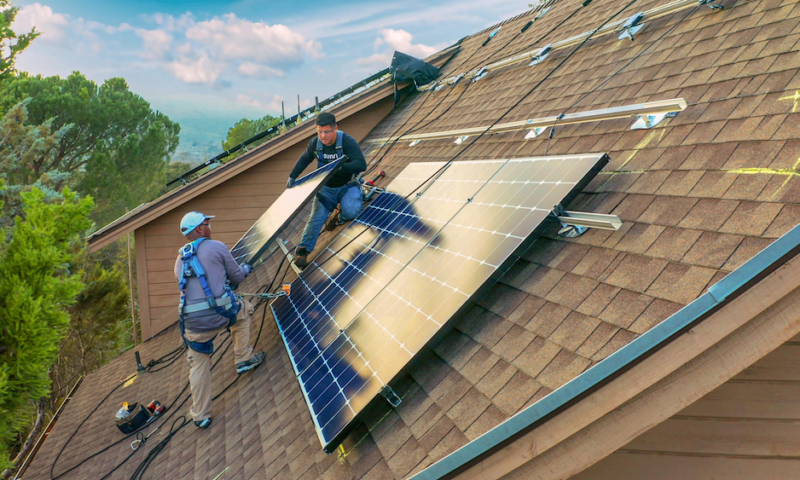
Net Metering: The California Solar Initiative rebate program is in place and working well to deploy a million solar energy systems on rooftops throughout the state. Through a wonky sounding but very important policy called “net metering,” California homes and businesses that go solar can reduce their electricity bills. Together, these programs have made California a real solar success story:
- California has installed more than 1,400 MW of rooftop solar capacity – that’s the equivalent of nearly three utility-scale coal or natural gas-fired power plants.
- California’s solar industry employs more than 43,000 workers. Solar job growth has been ten times higher than the overall economy’s growth, providing a rare bright spot during the recession.
- Solar has driven $10 billion in private investment in the state over the past 5 years, making it a real economic engine.
- Cash-strapped public agencies will save $2.5 billion in electricity costs of the next 30 years by going solar. Schools alone will save $1.5 billion.
- Rooftop solar has reduced the need for California ratepayers to invest in expensive and polluting peak generation and the transmission infrastructure needed to carry it.
- Local solar business innovation and scale has effectively driven costs down and made solar more accessible to more Californians. According to CPUC data, since 2009, 2/3 of California’s home solar installations have been in median income zip codes (household incomes of $85,000 or less).
The state’s stable, transparent, long-term policy has been key to its solar success. Click here for a fact sheet with snazzy infographics describing the ways net metering is working for the state.
Shared Solar: In 2013, Vote Solar will support the passage of legislation in Sacramento to create a shared renewable energy program for California. The new program will allow the three-quarters of Californians who aren’t able to install solar on their own roofs (because they are renters, or because their roofs are shaded, for example) to invest in an offsite solar project and get utility bill reductions in return. Learn more about the shared solar model here.
New report released 4/11: Economic and job benefits of California’s shared renewables proposal.
For wholesale solar power that delivers electricity to all Californians:
California has a comprehensive set of policies in place that boost demand for wholesale solar and remove barriers to its deployment, including the nation’s strongest renewables portfolio standard of 33% by 2020.
Transmission is a key issue if the state is going to meet those renewables goals with large-scale solar facilities. With the lawfirm of Keyes, Fox and Weidman, we intervened in R.08-03-010 before the CPUC, with the goal of ensuring that any transmission upgrades necessary to bring utility-scale solar generation will maximize conservation values and minimize impact.
In order to help bring more solar onto the grid in the meantime, we began an effort to address a policy gap for mid-sized solar systems by establishing a new program called the Renewable Auction Mechanism (RAM) to buy wholesale solar energy from such systems. The CPUC approved RAM, and solicitations are now moving forward for 1300 MW of projects of 3 to 20 MW in size. In addition, the CPUC has implemented legislation updating the statewide feed-in tariff program, for projects of 1 to 3 MW in size. And finally, the three investor-owned utilities in California have also established distributed generation PV programs to help meet their renewable energy requirements.
Vote Solar’s leads for California are Adam Browning (abrowning@votesolar.org) and Susannah Churchill (susannah@votesolar.org).